Table of Contents
- Why You Must Set Up Telegram Chat History Encryption?
- Core Types and Principles of Telegram Chat Encryption
- 1. End-to-End Encryption (Secret Chat)
- 2. Cloud Sync Encryption (Regular Chat Encryption)
- Cross-Platform Tutorial: Telegram Chat Encryption Step-by-Step
- 1. End-to-End Encryption (Secret Chat) Setup
- (1) Android Mobile Devices
- (2) iOS Mobile Devices (iPhone/iPad)
- (3) PC (Windows/Mac)
- (4) Web Version (Telegram Web)
- 2. Cloud Sync Encryption (Regular Chat) Enhancement
- Advanced Tips: 6 Security Enhancement Practices for Telegram Chat Encryption
- 1. Enable Chat Lock (Prevent Unauthorized Device Access)
- 2. Disable Chat Forwarding (Prevent Encrypted Content Leakage)
- 3. Regularly Create New Secret Chats (Reduce Key Leakage Risks)
- 4. Disable Read Receipts + Encrypted Chat Double Protection
- 5. Log Out of Unused Devices After Multi-Platform Login
- 6. Avoid Non-Encrypted Chats on Public Networks
- Frequently Asked Questions (FAQ)
- Q1: Will Secret Chat records be backed up to iCloud/Google Drive?
- Q2: Is cloud encryption for regular chats secure? Can it be hacked?
- Q3: Does Secret Chat support group chats?
- Q4: What if I forget my chat lock password?
- Q5: How to confirm if the other party has enabled encrypted chat?
- Conclusion
In an era rife with data breaches and privacy leaks, encryption features have become a core demand for users choosing communication tools. As a world-class messaging app renowned for privacy and security, Telegram offers multi-layered chat history encryption solutions. These cater to both ordinary users' daily privacy needs and high-intensity security requirements for scenarios like business communications and sensitive information transmission. Whether you aim to prevent chat content from being stolen by third parties, avoid data leaks if your device is lost, or safeguard trade secrets, mastering Telegram chat encryption setup is crucial. This article details the operation steps for core features such as end-to-end encryption (Secret Chat) and cloud sync encryption, covering Android, iOS, and PC platforms. It integrates high-frequency search keywords and long-tail terms for Google and Bing, helping you quickly build a secure communication environment.
Why You Must Set Up Telegram Chat History Encryption?
Before learning the operations, clarify the core value of chat encryption—this is a key demand frequently searched by global users and an essential part of privacy protection in the digital age:
- Defend Against Third-Party Eavesdropping and Theft: Public Wi-Fi (e.g., café networks), malware, and cyber attacks may intercept chat content. Encryption ensures only senders and recipients can decrypt data during transmission and storage;
- Prevent Information Leakage After Device Loss: Unencrypted chat records could be directly accessed if your phone or computer is lost. Encryption acts as the final security barrier;
- Protect Sensitive Information: Encrypting business negotiation details, financial data, and personal privacy (e.g., home addresses, health information) prevents illegal access and abuse;
- Comply with Regulatory Requirements: Industries like finance, law, and healthcare have strict encryption compliance standards for information transmission. Telegram’s encryption features meet the usage specifications for these scenarios;
- Mitigate Risks of Stolen Accounts: If your Telegram account is compromised, encrypted chat records require additional verification to access, reducing the impact of information leaks.
Core Types and Principles of Telegram Chat Encryption
Telegram provides two core encryption methods, each adapted to different use cases with distinct underlying principles and security levels:
1. End-to-End Encryption (Secret Chat)
- Core Principle: Adopts AES-256 encryption algorithm and RSA key exchange protocol. Chat data is only stored and decrypted on the sender’s and recipient’s devices. Telegram servers only relay encrypted data packets and cannot access the original content;
- Key Features:
- No multi-device sync support—only visible on the device where the encrypted chat was created;
- Configurable auto-destruct timer (1 second to 1 week) for messages, which are automatically deleted after the countdown ends;
- Screenshot prevention (some devices display "Screenshots disabled by the other party");
- Chat history is not backed up to the cloud and cannot be recovered after app uninstallation;
- Use Cases: Transmitting highly sensitive information, temporary confidential communications, and scenarios where chat retention is unwanted.
2. Cloud Sync Encryption (Regular Chat Encryption)
- Core Principle: Enabled by default as a basic encryption feature. Chat data is encrypted with TLS 1.3 during transmission and AES-256 when stored on Telegram’s cloud;
- Key Features:
- Supports multi-device sync (accessible on phones, PCs, and web clients);
- Chat history is automatically backed up to the cloud and recoverable after logging in on new devices;
- No auto-destruct or screenshot prevention functions;
- Use Cases: Daily non-sensitive communications and scenarios requiring cross-device chat access.
- Important Note: Telegram regular chats only enable basic cloud sync encryption by default. End-to-end encryption requires manual creation of a Secret Chat—a common point of confusion for most users.
Cross-Platform Tutorial: Telegram Chat Encryption Step-by-Step
1. End-to-End Encryption (Secret Chat) Setup
End-to-end encryption is Telegram’s highest level of privacy protection. Below are detailed steps for each platform:
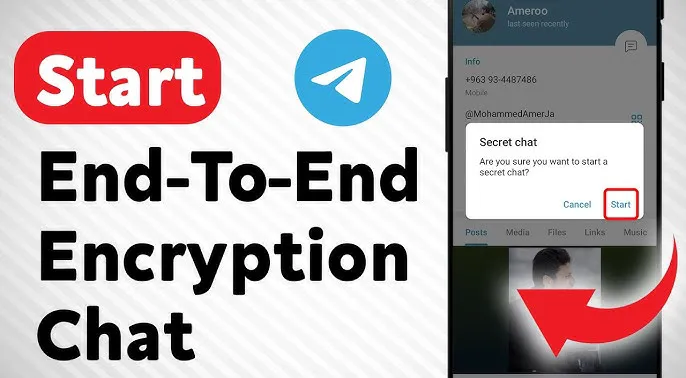
(1) Android Mobile Devices
- Open the Telegram app and navigate to a chat with the target contact or find them in your contact list;
- Tap the three-dot icon (More Options) in the top-right corner of the chat interface and select “New Secret Chat” from the dropdown menu;
- A “Secret Chat Created” notification will appear, along with an optional “Encryption Key Verification” feature:
- Tap “Verify” to confirm the other party’s identity via QR code scanning or digital key comparison, preventing man-in-the-middle attacks;
- (Optional) Set message auto-destruct: Tap the timer icon at the top of the chat interface and select a duration (1 second, 1 minute, 1 hour, 1 day, 1 week). Messages sent afterward will start counting down and delete automatically after being viewed;
- Setup Complete: The chat interface will display a “Secret Chat” label at the top with a dark background, indicating end-to-end encryption is active.
(2) iOS Mobile Devices (iPhone/iPad)
- Open the Telegram app and enter the chat with your target contact;
- Tap the contact’s avatar in the top-right corner to access their profile page;
- Scroll down the profile and tap “New Secret Chat”—the app will automatically redirect to the encrypted chat interface;
- Key Verification: Tap “Verify” at the top to confirm the contact’s identity via in-person QR code scanning or 6-digit key comparison;
- Auto-Destruct Setup: Tap the timer icon on the left side of the chat box and select your preferred duration—changes take effect immediately;
- Note: iOS Secret Chats do not support group chats and are limited to one-on-one encrypted communications.
(3) PC (Windows/Mac)
- Open the Telegram desktop client, log in, and locate the target contact in the left sidebar;
- Right-click the contact and select “New Secret Chat” from the context menu;
- A new window will open with a “Secret Chat” label at the top;
- Key Verification: Tap “Verify” at the top to complete verification via mobile QR code scanning or key string comparison;
- Auto-Destruct Setup: Tap the timer icon above the chat box and select a duration. Messages will delete according to the set rules;
- Advantage: PC Secret Chats support encrypted file transfer via drag-and-drop. Files are only stored on both parties’ devices and not uploaded to the cloud.
(4) Web Version (Telegram Web)
- Visit Telegram’s official web version in your browser and log in via QR code;
- Right-click the target contact in the left sidebar and select “New Secret Chat”;
- Follow the same steps as the PC client: Verify Key (optional) → Set Auto-Destruct (optional) → Start Encrypted Chat;
- Limitation: Web version Secret Chats do not support encrypted file transfer—only text and emoji messages are encrypted.
2. Cloud Sync Encryption (Regular Chat) Enhancement
Basic cloud encryption is enabled by default for regular chats. Use the following steps to further enhance security:
- Cross-Platform General Steps:
- Go to Telegram’s Settings → Privacy and Security;
- Scroll down to Cloud Settings and enable “Encrypt Cloud Data” (enabled by default—recommended to confirm);
- Enable “Two-Step Verification”: Bind an email address and set a unique verification password to prevent unauthorized access to cloud chat history if your account is stolen;
- Additional Optimizations:
- Disable Auto-Download Media: In Privacy and Security → Data and Storage, turn off “Auto-download media” to avoid malicious files being stored on your device automatically;
- Regularly Clear Cloud Backups: Tap Data and Storage → Manage Cloud Storage to delete unnecessary chat backups and reduce leakage risks.
Advanced Tips: 6 Security Enhancement Practices for Telegram Chat Encryption
1. Enable Chat Lock (Prevent Unauthorized Device Access)
Even with encryption, chat records may be accessed if your device is unlocked by others. Recommend enabling chat lock:
- Go to Settings → Privacy and Security → Passcode Lock;
- Set a 4-digit PIN or custom password (supports letters, numbers, and special characters);
- Select an auto-lock duration (1 minute, 5 minutes, 15 minutes, 1 hour, Never). The app will lock automatically after being idle for the selected time and require the password to reaccess;
- iOS users can enable Face ID/Touch ID Unlock; Android users can enable Fingerprint Unlock for added convenience.
2. Disable Chat Forwarding (Prevent Encrypted Content Leakage)
In Secret Chats, you can prohibit the other party from forwarding content to further protect privacy:
- Enter the Secret Chat interface and tap the three-dot icon in the top-right corner;
- Select “Disable Forwarding”—the other party will no longer be able to forward chat records to other windows.
3. Regularly Create New Secret Chats (Reduce Key Leakage Risks)
Long-term use of the same Secret Chat may increase the risk of key compromise. Recommend:
- Creating a new Secret Chat every 1-2 weeks for sensitive scenarios (e.g., business negotiations);
- Re-verifying the encryption key each time to ensure a secure communication environment.
4. Disable Read Receipts + Encrypted Chat Double Protection
Sync disable read receipts in Secret Chats to prevent the other party from judging your online status:
- Go to Settings → Privacy and Security → Read Receipts;
- Disabling this feature means the other party will not see if you’ve read their encrypted messages, enhancing privacy further.
5. Log Out of Unused Devices After Multi-Platform Login
Multi-device login may increase the risk of encrypted chat leakage. Recommend:
- Go to Settings → Privacy and Security → Active Sessions;
- Review all logged-in devices, including IP addresses, locations, and login times;
- Tap “Terminate Session” for unused devices (e.g., public computers, old phones) and change your account password immediately if unfamiliar devices are detected;
- Check active sessions regularly (recommended monthly) to ensure only your trusted devices are logged in.
6. Avoid Non-Encrypted Chats on Public Networks
Public Wi-Fi networks pose security risks. Recommend:
- Prioritizing Secret Chats when connected to public networks;
- Using a mobile hotspot or VPN to encrypt the network transmission channel if regular chats are necessary.
Frequently Asked Questions (FAQ)
Q1: Will Secret Chat records be backed up to iCloud/Google Drive?
A: No! End-to-end encrypted Secret Chat records are only stored locally on the device where the chat was created. They are not backed up to any cloud services (including iCloud, Google Drive, or Telegram’s own cloud). Records will be permanently lost if the app is uninstalled or the device is factory reset.
Q2: Is cloud encryption for regular chats secure? Can it be hacked?
A: Telegram’s cloud encryption for regular chats uses TLS 1.3 + AES-256 double encryption, meeting international security standards and remaining unhackable under normal circumstances. However, note: If your account is stolen without two-step verification enabled, others can access cloud-backed regular chat records. Thus, two-step verification is a fundamental account security measure.
Q3: Does Secret Chat support group chats?
A: No! Telegram Secret Chats only support one-on-one encrypted communications. Group chats only offer basic cloud encryption and do not support end-to-end encryption. For encrypted group communications, consider using Telegram’s sibling app「Telegram X」or third-party encryption plugins (choose reputable tools cautiously).
Q4: What if I forget my chat lock password?
A: If you forget your passcode lock password, reset it using these steps:
- Go to Settings → Privacy and Security → Passcode Lock;
- Tap “Forgot Passcode”—the system will prompt you to delete all lock settings without removing chat records;
- Set a new password after resetting.
Q5: How to confirm if the other party has enabled encrypted chat?
A: Secret Chats display a clear “Secret Chat” label at the top with a dark background (regular chats have a light background); Regular chats have no special indicators, but you can confirm cloud encryption is enabled via Settings → Privacy and Security → Cloud Settings. Additionally, attempting to take a screenshot in a Secret Chat will show “Screenshots disabled by the other party”—a feature not available in regular chats.
Conclusion
Telegram chat encryption is a core feature for protecting communication privacy. End-to-end encryption (Secret Chat) offers the highest security level for sensitive information transmission, while cloud sync encryption suits daily communications and cross-device access needs. With this cross-platform tutorial, you can quickly set up encryption on Android, iOS, PC, or web clients.
For comprehensive security protection, combine advanced practices like “Two-Step Verification + Chat Lock + Regular Cloud Backup Cleaning” to build a multi-layered privacy defense system. Remember, encryption is not a “set-it-and-forget-it” solution. Regularly check your account security status, update the app (to get the latest security patches), and avoid logging in on untrusted devices to maintain long-term chat security.
If you need further information on recommended Telegram encryption plugins, enterprise-level encryption solutions, or customized security advice for specific scenarios (e.g., cross-border business communications, family privacy protection), feel free to share your requirements—I’ll provide more targeted solutions!